How diamonds form?
 |
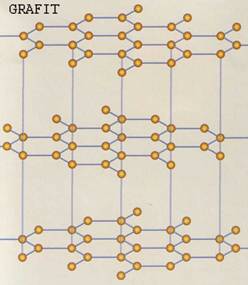 |
A diamond consists of a carbon and graphite. The difference in hardness occurs because of the way in which the atoms are connected. Atoms of graphite are arranged in tightly linked layers, but the layers are weakly bounded. Diamond atoms are connected to each other by covalent bonds in a tetrahedron. That is why the graphite is soft and the diamond is the hardest substance in the world.
Terms under which diamonds are formed are a temperature range of 900° C to 1300° C and pressure between 45 and 60 kilo bars. Normal Earth pressure at sea level is approximately 1 bar.
The Earth’s three main layers are the crust, the mantle and the core. Areas for diamond formation, because of the specific conditions, are placed on restricted areas of the upper mantle of the Earth at depth of 140 to 190 km. The best temperature and pressure conditions for diamond formation exist under large, geologically stable parts of the crust called cratons. Cratons are the oldest sections of the landmasses.
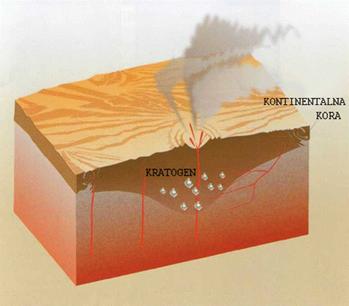 The basic requirements for diamond formation are precise temperature and pressure conditions in the right combination, and an environment rich in carbon. Diamonds form in two different types of igneous rocks, and they are called peridotite and eclogite. Most of the diamonds form from the perodite, which melts in the earth’s inner heat, and releases the carbon. Eclogite is a younger rock than perodotite and occurs at much shallower levels. Its carbon comes partly from organic matter. The carbon release occurs due to a process called subduction. It’s a process in which two crustal plates collide, forcing one under the other.
In both peridotite and eclogite, if temperature and other factors like pressure and chemistry are favourable, the carbon atoms released by the melting rock bond to build diamond crystal.
After formation, if conditions remain constant, diamonds might remain underground for hundreds of millions of years before they are carried to the surface.
Diamond deposits are found in two types of rocks: kimberlite and lamproite. Their mineral and chemical compositions are similar. The main difference between them is while kimberlite tends to occur in the middle of cratons, lamproite is commonly found at he edges of cratons, or even in the zones immediately around them.
The molten rock material, called magma, expands as it heats up.
The heated magma rises towards the surface and if it passes through a diamond deposit, it will pick up and carry already-formed diamonds.
Diamonds can convert to graphite if they are exposed to high temperature along with decreased pressure for a long period, which would mean that the process of exiting magma is not completed within a specific period.