Exploring for diamonds
A diamond is a natural product with limited supplies. Mines that were once profitable are now abandoned. Therefore, there is a need for seeking new sources. A major motivation for seeking new sources is the expansion of the global diamond market. Another factor is that affordable labour and new technologies are now available for cutting smaller, lower-quality diamonds.
Exploring for diamonds is a long, difficult and expensive process. The first years are devoted to locating a source and determining if there are enough good quality diamonds to justify mine construction. Besides that, the geography and climate of an area, the distance from populated area, political conditions and environmental concerns are also important.
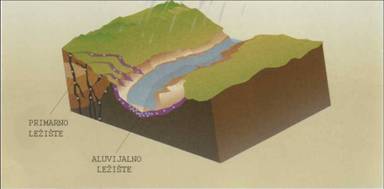 After waiting deep underground for millions of years, diamonds are carried out rapidly to the surface. At the surface, they burst through the crust and settle back into deep deposits called pipes. Alluvial deposits are deposits where diamonds are eroded from their source rock. When a pipe erodes, its diamonds might remain nearby or they might spill into neighbouring rivers and streams. Gemstones found in the rock that carried them to the surface, are found in primary deposits. Secondary deposits are deposits where gemstones are found away from their primary source. A marine deposit is a secondary diamond deposit carried by rivers or streams to the ocean floor or shoreline.
For at least 2000 years, alluvials were the only diamonds known to exist. Alluvial and marine deposits are generally richer in diamonds than primary deposits.
To determine a mine’s potential, mining companies evaluate three factors:
- - Size of the deposit,
- - Concentration of rough diamonds within the pipe, called ore grade,
- - Size and quality of the rough diamonds.
It is very important to decide where to look for diamonds, to select the area, to look for certain minerals, to detect a cluster of pipes and to test the actual presence of diamonds.
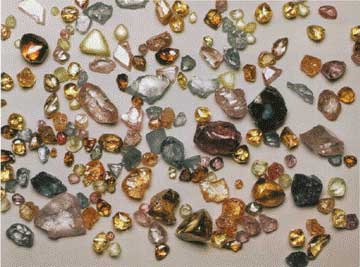 Rough diamonds are classified as Cuttable rough or Industrial rough. Cuttable rough diamonds include all diamonds with good enough size, shape, clarity and colour to produce a polished stone suitable for use in jewellery. Industrial rough probably will not find their way into jewellery. They are suitable for use in tools, drills, abrasives and other industrial applications because of their exceptional hardness.