Diamond mining
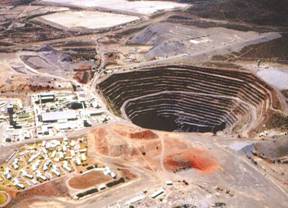 The picture shows South Africa’s "Finsch mine", which was converted to an underground operation when the open pit reached a depth of 430 meters.
Most diamond-mining operations are large in scale and extremely expensive. They consist of a giant excavation, equipped with sophisticated remote-controlled robotics and automated machinery.
Some mines are located outside populated areas, so it is necessary for the miners to have the possibility to settle with adequate infrastructure.
The basic approach to mining is to dig out and remove all the material in and around the layers that cover the pipe. Miners remove the overburden and process it for any diamonds it might contain.
Then they drill holes into pipes, insert explosives into the holes and blast the ore loose. They use low-velocity charges and place them carefully to avoid shattering the diamonds. Then they remove the loosened material with hydraulic shovels and large ore trucks. The ore starts out in fairly large chunks that must be reduced in size by crushing and scrubbing operations.
Dense media separation, also known as heavy media separation, separates diamond-bearing gravel from the lighter waste materials. The crushed and scrubbed ore is mixed with a liquid and fed into a cone-shaped container called a cylinder.
The diamonds are finally separated from the gravel using a grease belt. It is an apparatus that uses diamond’s affinity for grease to separate them from the other materials.