Diamonds and colour
Many people think that diamonds are colourless, but most diamonds contain a small amount of colour. The colour ranges from colourless to light yellow and brown.

Red, green, purple and orange are generally the rarest, followed by pink and blue. Yellows and browns are the most common colours.
The colour consists of three elements and they are hue, tone and saturation.
- - Hue is the first impression of colour; the basic colour of an object.
- - Tone is colour’s degree of darkness or lightness.
- - Saturation - Saturation is colour’s strength or intensity, ranging from dull hue to pure, vivid hue.
When visible white light enters the diamond, the diamond absorbs some of the spectral bands or wavelengths. The rest of the light returns to the viewer’s eye and determines the colour of the diamond.
Richard T. Liddicoat, at GIA, developed the colour grading scale in the 1950s. It describes the normal colour range from D (colourless) to Z (light yellow or brown). Each letter represents a range of colour based on a diamond’s tone and saturation.
GIA colour scale
|
colourless
|
near colourless
|
slightly tinted
|
very light yellow
|
light yellow or brown
|
||||||||||||||||||
|
D
|
E
|
F
|
G
|
H
|
I
|
J
|
K
|
L
|
M
|
N
|
O
|
P
|
Q
|
R
|
S
|
T
|
U
|
V
|
W
|
X
|
Y
|
Z
|
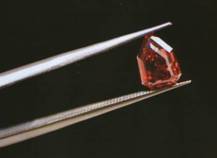 Diamonds can also be coloured. Methods used for colouring diamonds range from primitive to very high-tech. Diamonds can be treated to alter or add colour by coating, irradiation, heating or by a combination of irradiation and heating. Professional sales representatives inform their customers about the colour treatments.
Fancy-coloured diamonds are rarer than the diamonds in the normal colour range.
The value of diamonds generally increases with the strength and purity of the colour.