Diamond cutting
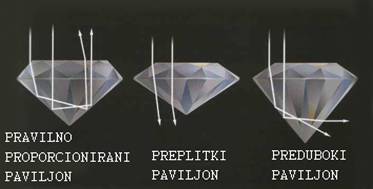
When a light ray strikes a diamond, it either reflects off the surface or enters the diamond. If it reflects off the surface, you see it as a flash of white light, which is a part of the diamond brilliance. The complexed nature of a diamond’s structure influences the decisions manufacturers make, such as where and how to divide rough to the potential weight, cut and clarity of the finished diamond. These decisions affect the diamond’s ultimate value. The light ray needs to enter at certain angle to create the wanted appearance of a diamond. If air enters at the wrong angle, or the cut is badly done, it will result the bad diamond brilliance. This is called the light leakage.
 Diamond graders use five terms to describe a diamond’s polish and symmetry:
Excellent (Ex),
Very Good (VG),
Good (G),
Fair (F),
Poor (P).
The goal of diamond manufacturers is to get the most value from a piece of rough and to maximize quality and lower costs while creating exceptional diamonds.
 Method of cutting a diamond requires its careful examination and the cutter’s challenge is to produce the most attractive and the most profitable finished gem at the lowest price.
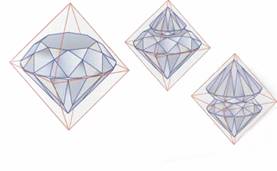
The point cut was the earliest diamond cut, and it was popular in the 15th century. It closely followed the rough's octahedral shape. The polishing changed the natural octahedron's angle by only a few degrees, which made point cuts difficult to tell apart from natural octahedral rough.
The table cut dominated diamond jewellery through the 15th and into the 16th century. To create a table cut, the cutter removes the top point of the octahedron's double pyramid. It generally improves the amount of light returned to the viewer.
The rose cut appeared in the early 16th century and was popular until the 19th century. Unlike the table cut, it wasn't designed for octahedral rough. Instead, it proved an efficient way to produce the largest possible gem from flattened rough. Rose cut gems have flat bottoms and triangular facets that come to a point at the top.
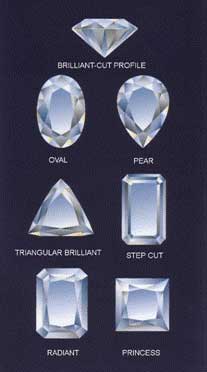
The brilliant cut is the most popular cut on the market.
The princess cut makes excellent use of diamond rough. It minimizes waste and emphasizes the diamond's brilliance.

The fancy cut comes in different variations and shapes.