Diamond simulants
Diamond is one of the world's most popular gemstones. Its dazzling appearance and universal appeal have inspired a wide variety of less expensive lookalike materials. Some of them come from the ground, and some from the lab. The imitations are called simulants. Simulants are not synthetic diamonds and synthetic diamonds are not simulants. One thing that makes simulants important for the jewellery industry is that they can be manufactured in quantity; therefore, they are readily available and less expensive than diamonds.
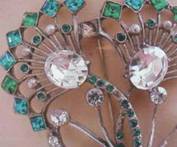 Glass (SiO2) has been an effective diamond imitation since the 1700s, when European glassmakers discovered that adding lead oxide to glass made it much more dispersive and brilliant. The process resulted in a convincing diamond simulant, which is even today used in less expensive fashion jewellery.
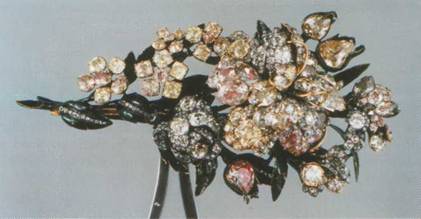 Foilback is a gemstone or simulant with a thin metallic foil or mirroring film applied to its pavilion.
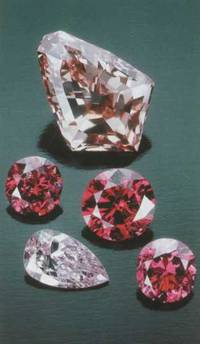
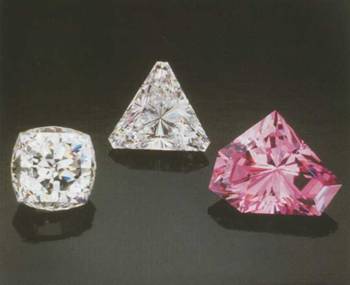
Zircon (ZrSiO4) is a natural gem that occurs in variety of colours. Its colourless form was rare until the early 20th century, when heat-treating methods made it more common. Zircons chip and scratch easily because they are allocated quite soft on Mohs’ hardness scale (7 ½).
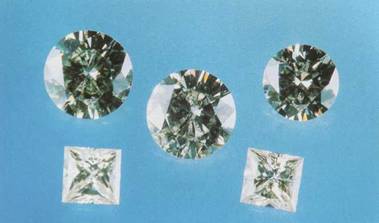 Synthetic cubic zirconia (ZrO2) is a modern simulant that entered the market in the early 1970s. It has since become the most common of all the diamond simulants. Coloured zirconia has the look of fancy-coloured diamonds at a fraction of the cost. It is more used in jewellery making because it is allocated higher on Mohs' hardness scale (8,5).
Zircon and synthetic cubic zirconia have a similar name, which is why they are often mistaken, although their structures are different.
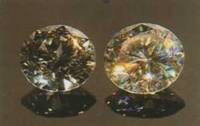 Synthetic moissonite (SiC) is a silicon carbide. It gets its name from Dr. Henri Moissan who discovered the natural mineral in 1893 while analysing an ancient meteorite in Arizona. There was never enough of natural moissonite so it was introduced as a diamond simulant in the late 1990s. Although it tends to be slightly yellowish or greenish, synthetic moissonite is a convincing diamond simulant. Its hardness is about 9 ½ on the Mohs' scale.
Synthetic rutile (TiO2) was discovered by accident in 1948 but it served briefly as a diamond simulant. It is because its hardness is very low on Mohs' scale of hardness (6 ½) and its obvious rainbow colours which detract from its brilliance.
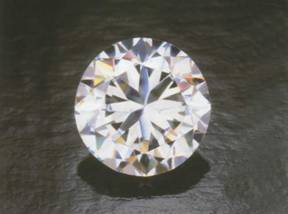 Strontium titanate (SrTiO3) first appeared as a simulant in 1953. Like diamond, it is singly reflective. It is closer to colourless and much less dispersive than synthetic rutile, but still noticeably more dispersive than diamond. It has low hardness (5-6 on Mohs' scale) so it is not very durable.
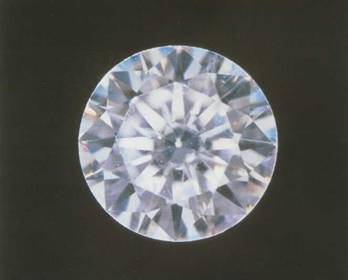 YAG (Y3Al5O12) is yttrium aluminium garnet. It was discovered in the late 1960s, when scientists developed a number of lab-grown crystals with garnet-like (cubic) crystal structure. It was the first to be said as a diamond simulant and aggressive promotion boosted yag's commercial success. It has relatively good hardness (about 8 ¼ on the Mohs' scale) but it lacks the distinct fire of diamond. As newer and better simulants appeared, yag lost its popularity.
GGG (Gd3Ga5O12) is gadolinium gallium garnet. Its dispersion is almost the same as diamond’s, so it shows similar fire. GGG's major drawback is its lower hardness (6 ½ on Mohs' scale) and it is much heavier than a diamond of the same size.
Although they are both manmade and have garnet-like structure, YAG and GGG are not synthetic garnets because they don't have the chemistry of any garnets known in nature.