Syntethic diamonds
Early searches for diamond lookalike later developed into searches for techniques to make diamonds. Researchers tried to find just the right combination of ingredients, temperature and pressure that would allow technology to do nature's work. In the 1950s, scientists began making synthetic diamonds. Now they are widely used in industry, mostly in cutting instruments and abrasives. A few found their way into the gem market.
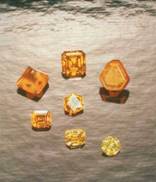 Most synthetic diamonds are small and yellow in colour. These specimens, produced in Russia, range from 0.14ct to 0.88ct.
Synthetic diamonds are made in the laboratory, and they have essentially the same chemical composition and crystal structure as natural diamonds.
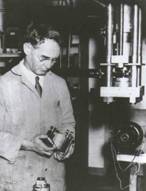 In 1941, Dr. Percy W. Bridgman, an America researcher who specialized in high –pressure physics, came to an agreement with the General Electric Corporation (GE) to design a laboratory especially for the production for synthetic diamonds. Before World War II interrupted the project, Bridgman and his colleagues made important advances in high-pressure technology, but no diamonds. In 1951, GE formed another research group to expand on Bridgman's work. By 1953, they had designed equipment capable of researching and maintaining extreme pressure and temperatures. After that, the only modifications they made were to the apparatus that actually held and compressed the raw materials. Finally, a belt-type apparatus designed by team member Dr. Tracy Hall succeeded. GE scientists created their first batch of synthetic industrial diamonds in December 1954.
A Swedish electric company made several tiny synthetic diamonds in 1953 but they decided that their method was too difficult, too slow and too costly to be commercially feasible. They didn't announce their accomplishment until two years after GE's success. By then, it was too late for them to be recognized as the first synthetic diamond makers.
In 1970, GE announced the creation of the first gem-quality synthetic diamonds. Use of synthetic diamonds in jewellery is limited because its production is still too costly.