Famous diamonds
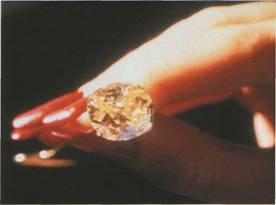 The EUREKA diamond comes from ancient Greek and it means "I found it". The raw diamond weighed 21.25 ct, and when cut it weighs 10.37 ct. It is yellow in colour and the cut is oval.
It was found in South Africa, by a farmer's son in 1866. Thinking that he found a beautiful stone, he gave it to his younger sister to play with it. His neighbor Niekerk suspected that it might have been a diamond. He subsequently passed a long way to appear at the Christie's auction house in 1974. "De Beers" bought it and returned it back to South Africa. The diamond is now displayed in the "Open Mine Museum".
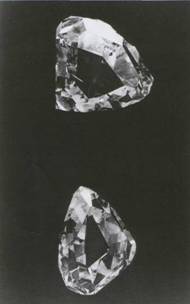 The CULLIAN diamond , unearthed in South America, weighed 3.106 ct. Once cut, it produced 9 large stones and 96 small brilliants. No matter what the size of the crystal, each step in the cutting process is dictated by the rough’s internal structure.
Early stages of polishing the largest, Cullinan I.
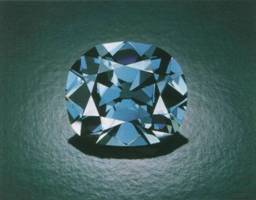 The HOPE diamond in a raw form weighed 110.50 ct. It is a large, 45.52 ct, deep blue diamond.
The history of the diamond that’s today known as the Hope, goes back to mid 17th century when Jean Baptist Tavernier bought a sapphire-blue diamond and named it the Tavernier Blue. In 1669, he sold the stone to Louis XIV, France’s Sun King. It became known as the Blue Diamond of the Crown and remained with the royal family until 1792.
The diamond later surfaced in London, where Henry Philip Hope bought it sometime before 1839 and gave it his family’s name. The stone stayed with the Hopes until 1901. It then took side trips to owners in Turkey and Paris.
In Paris, Pierre Cartier tried to enhance the diamond’s appeal. He used fictional tales and exaggerated stories to create the Hope’s famous "curse", which implied that bad luck followed anyone who owned it.
In 1958, a diamond merchant, Harry Winston, donated the diamond to the Smithsonian Institution in Washington, D.C., where it is still on public display and said to be the museum’s most popular attraction.
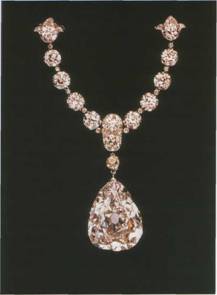 The STAR OF SOUTH AFRICA, also known as the DUDLEY , is a white diamond found in 1869, at a mine near Cape Hope, in South Africa. In its rough form the diamond weighed 83.50 ct, when cut its weight is 47.69ct.
The huge gem was named the Star of South and displayed in the South African Parlament building. Legend has it that it prompted the colonial secretary to predict: "This diamond, gentlemen, is the rock upon which the future prosperity of South Africa will be built." There is no evidence the secretary or anyone else said that. But the Star’s discovery sparked the diamond rush that followed.
Louis Hond, a London cutter, bought the Star in 1870 and fashioned it into a 47.69ct pear-shaped brilliant. He sold the gem to the Earl of Dudley and Lady Dudley had it set in a hair ornament surrounded by 95 smaller diamonds. Since then, it has sometimes been called the "Dudley."
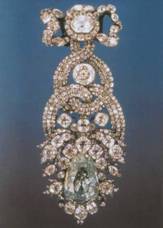 The DRESDREN GREEN is the largest, 41ct natural-colour green diamond known to be in existence. "Luscious apple green" often describes the colour of the unique, modified pear shape.
The diamond is exceptional because of the even distribution of its bodycolour. The rare, green hue is actually caused by exposure to radiation over a long geological time span.
The Dresden Green is displayed in Germany as part of the Arts Collection of Dresden.
In 1768, a jeweller from Prague designed this hat ornament specifically to hold the 41ct Dresden Green diamond.